
Soccer drills for 10 year olds: what to run, in what order
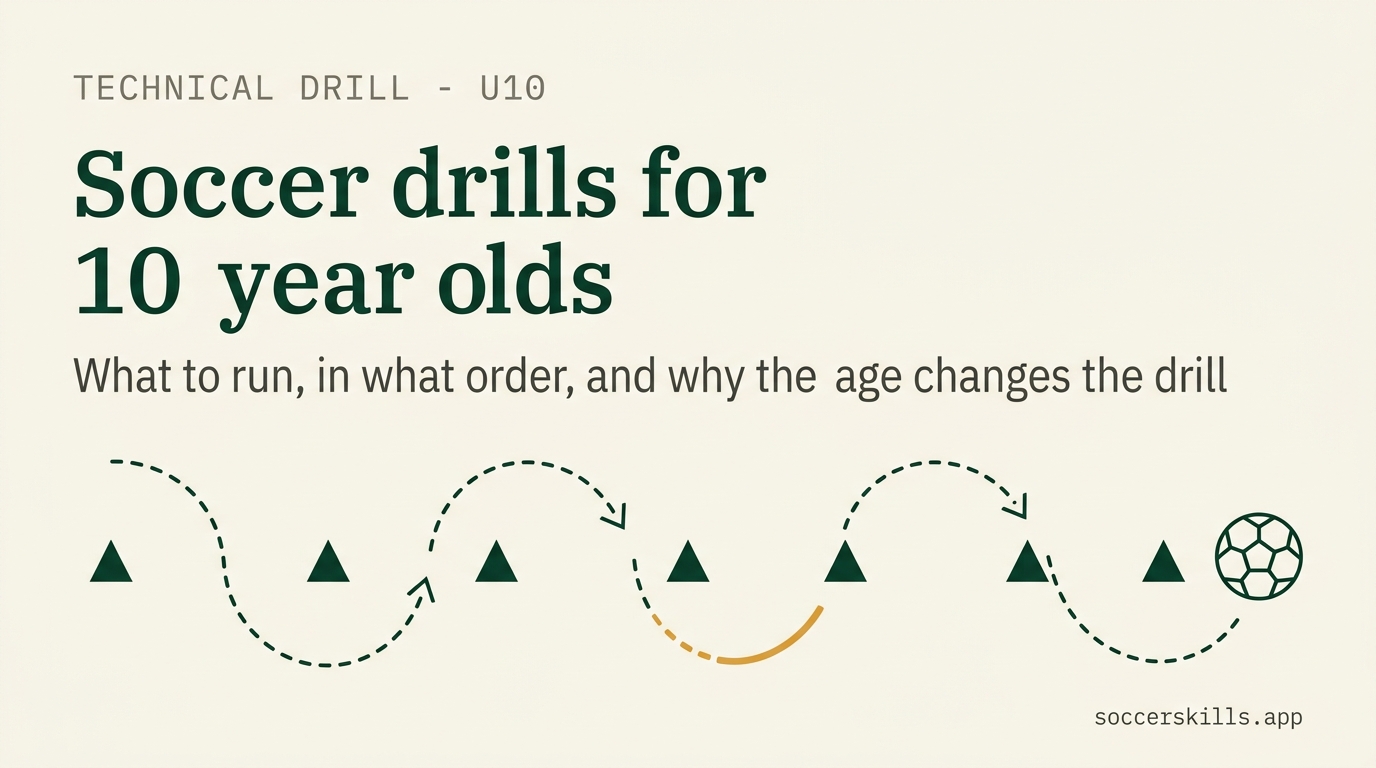
The soccer drills for 10 year olds worth running are the ones with a ball on the foot almost every second: toe-taps, sole rolls, pull-backs, cone weaves, inside-outside dribbling, wall passing, first-touch traps, and 1v1 to a line. Ball mastery first, decision-making last. A U10 gets better by touching the ball a few hundred times, not by learning where to stand on a full field.
The order matters as much as the list. The age matters more than either.
Which soccer drills for 10 year olds are worth the time
Eight drills cover almost everything a U10 needs, and they sort into three jobs: ball mastery in place, dribbling with direction, and first touch with a bit of pressure on it.
Ball mastery is the boring, brilliant part. Toe-taps for rhythm and light feet, worked 30 seconds on and 15 off. Sole rolls, one foot at a time, the ball moving side to side under the studs. Pull-backs, where the ball goes forward two steps and gets dragged back with the sole, which is the whole basis of every turn your kid will make for the next decade.
Then the ball starts travelling. Six cones in a line, roughly a metre apart. Inside of the foot on the way past, outside of the same foot on the exit, which teaches both surfaces without switching drills. Then the same six cones as a straight weave, two runs slow enough to stay clean, one run fast enough to feel uncomfortable.
The last block is receiving. Toss the ball up by hand and kill it dead with a thigh, chest, or laces. Two-touch against a wall, then one-touch, both feet, until the wall stops being interesting. And then 1v1 to a line, two cones as a gate, a defender who genuinely tries.
Ball mastery goes first, because a tired U10 does it badly, and dribbling sits in the middle while the feet are still clean. Then the 1v1 at the end, where a kid who has already made four hundred touches beats a defender with something they practised twenty minutes ago. That is the moment the drill turns into soccer.
All of it works with one ball, six cones, and a wall. Nothing on the list needs a field.
Why the drill has to match the age
A drill fits a 10 year old when it asks for coordination and repetition rather than load, tactical memory, or maximal effort. That one test rules in most ball work and rules out almost everything that looks impressive on a highlight reel.
Four things are true at U10 that stop being true later. Coordination is learning fast right now, somewhere between 8 and 12, and whatever gets grooved sticks. A pull-back learned cleanly at 10 is still there at 15, and so is a sloppy one, which is the entire argument for slow correct reps over fast messy ones.
Focus runs in short blocks. A U10 holds a drill for a few minutes before the quality quietly falls off a cliff, and the fix is more drills of shorter length rather than one long drill with more coaching in it.
Touches beat tactics, and the federation agrees. U.S. Soccer puts U9 and U10 players in 7v7 instead of 11v11 specifically so each kid is more involved, which their own explanation of the small-sided standards lays out plainly. If the governing body is shrinking the game to raise touch count, a backyard session should not be spending its twenty minutes on shape.
And the bones are still growing. Growth plates stay open across this age band, and the American Academy of Pediatrics guidance on resistance training is clear that technique and supervision come before load for children. Weighted work and heavy plyometrics are not U10 problems to solve.
The short version: if a drill needs a whistle, a formation, or a weight, it probably is not a U10 drill.
A 20-minute U10 practice session, minute by minute
Twenty minutes is enough at U10 when the session is dense, and this is the shape that survives contact with a real Tuesday evening.
The first three minutes are movement prep. Ankle hops, skips, side shuffles, two-leg landings. On any day the session finishes with sprinting or live 1v1 work, run the full FIFA 11+ Kids warm-up instead and give yourself ten extra minutes.
Minutes three to eight are ball mastery in place. Toe-taps, sole rolls, pull-backs, worked 30 seconds on and 15 off with the pattern rotating. This block is where the touch count comes from, so protect it.
Minutes eight to fourteen move the ball. Six cones, inside-outside through the line, pull-back turn at each end, two slow runs and one fast one.
Minutes fourteen to eighteen are first touch and passing. Wall passing at two touches, then one, then traps out of the air off a hand-toss. Both feet every set, no exceptions, because the weak foot only gets built when someone insists.
The last two minutes are 1v1 to a line. A parent, a sibling, a teammate. Short reps, full effort, finish while it is still fun.
Three of these a week beats one long weekend session by a distance. Twenty minutes on Tuesday, Thursday, and Saturday puts a kid well ahead of ninety minutes on Sunday and nothing else.
How many touches a 10 year old should get in a session
Aim for several hundred ball contacts in twenty minutes, and count contacts instead of counting drills. The arithmetic is kinder than it sounds. Toe-taps at a steady rhythm clear a hundred contacts a minute without trying, so the five-minute ball mastery block on its own does most of the work. Cone weaves add a dozen or so per run.
A 7v7 game does not come close. Most U10s touch the ball a modest number of times across a whole match, and plenty of those touches arrive under pressure nobody has taught them to handle yet. Team training splits whatever is left across a full squad. The volume genuinely lives in the at-home session, which is a strange thing to accept as a parent and also true.
The habit worth building is counting one block a week. Watch a single 30-second toe-tap rep, count the contacts, multiply. If the number comes back low, the drill is too complicated or the ball is drifting too far from the feet.
Warm-up and strength rules at U9 and U10
At U9 and U10 the strength work is bodyweight only, and the warm-up is FIFA 11+ Kids rather than the standard FIFA 11+. The standard programme was built and validated for players 14 and up, and it carries Nordic hamstring curls and box jumps that assume adolescent biomechanics your kid does not have yet.
FIFA 11+ Kids is the age-adapted version from the same research lineage, aimed at roughly ages 7 to 13. The multinational trial in Sports Medicine followed nearly 4,000 children across four countries and found 48 percent fewer injuries overall, 74 percent fewer severe injuries, and 55 percent fewer lower-extremity injuries against a normal warm-up. We walked through the whole age split in Is FIFA 11+ safe for U10?, which is the better read if your kid's team is currently running the adult routine.
Strength at this age is bodyweight, full stop: squats to a box, push-ups, planks, single-leg balance, glute bridges. The NSCA position statement on youth resistance training backs resistance training for children when it is supervised, technique-first, and progressed slowly. What neither the NSCA nor the AAP supports is loading a 10 year old to find out what they can lift.
This is general information for healthy kids, not medical advice. Current pain, a recent injury, or a known condition is a conversation with your child's physician before the next session rather than after it.
What to skip at U10
Skip anything that trades touches for standing around. Long lines, full-field shape work, drills where one kid works and ten watch. That filter alone removes most of what goes wrong in a youth practice.
Position specialization can wait, and the AAP's guidance on sports specialization recommends delaying it. A 10 year old locked into one spot on the field stops developing the skills every other spot demands.
Static stretching before a session belongs after it, if at all, because the warm-up is supposed to be movement. Heavy or reactive plyometrics are not U10 work either. Skipping, hopping in place, and clean two-leg landings are.
An agility ladder is fine for three minutes of footwork and is not a session, because there is no ball in it. And the same AAP guidance asks for real time away from organized soccer during the year. The kids who take it tend to come back sharper.
How to keep a 10 year old running the same drills
Change the constraint, not the drill. These eight will not need replacing for years, but a U10 will walk away from any of them if Thursday feels identical to Tuesday.
The constraints that work are small. A time target on the cone weave. Weak foot only. One touch instead of two. A narrower gate. Eyes up on a called number. Each one keeps the movement pattern intact and changes the problem in front of it, so the kid experiences a new drill while the reps keep piling onto the thing that matters.
The other half is naming. "Sole rolls" is a textbook term nobody has ever been excited about. Whatever your kid starts calling it in week two is the name that gets them out the door in week five.
Frequently asked questions
What drills should a 10 year old soccer player do?
Toe-taps, sole rolls, pull-backs, cone weaves, inside-outside dribbling, wall passing, first-touch traps, and 1v1 to a line. Run ball mastery first, dribbling second, and 1v1 last. All eight work with one ball, six cones, and a wall.
How long should a U10 practice be?
Twenty minutes for an at-home session, three times a week. A U10's focus holds for short blocks, so density beats duration. Team training runs longer because it includes small-sided games, but the solo skill work should stay short and frequent.
How many touches should a 10 year old get?
Several hundred in a twenty-minute session. Toe-taps and sole rolls alone produce over a hundred contacts a minute, so a five-minute ball mastery block does most of the work. Count contacts on one 30-second rep and multiply rather than guessing.
Is FIFA 11+ safe for a 10 year old?
The standard FIFA 11+ is validated for ages 14 and up. Run FIFA 11+ Kids instead, the age-adapted version for roughly ages 7 to 13. The multinational trial reported 48 percent fewer injuries overall and 74 percent fewer severe injuries.
Can a 10 year old do strength training?
Yes, bodyweight only and supervised. Squats to a box, push-ups, planks, single-leg balance, glute bridges. The NSCA and the American Academy of Pediatrics both support supervised, technique-first resistance training for children, and both put technique ahead of load at this age.
How many days a week should a U10 train at home?
Three short sessions a week, on days that do not sit next to a match. Twenty minutes on Tuesday, Thursday, and Saturday beats ninety minutes on Sunday, because motor patterns stick through frequent repetition rather than long single blocks.
Should a U10 specialize in one position?
No. The American Academy of Pediatrics recommends delaying sport and position specialization, and a 10 year old fixed at one position misses the technical demands of the others. Rotate positions in team play and keep the home drills position-neutral.
What equipment do you need for U10 soccer drills at home?
One size 4 ball, six cones, and a flat wall. Cones can be anything that stays put. A rebounder helps with wall passing but is optional, and a full-size goal is not needed for anything on the U10 list.
Are cone drills or 1v1 better for a U10?
Both, in that order. Cone drills build the technique and give the touch volume. The 1v1 forces the kid to use it against a defender who is actively taking it away. Cone work without 1v1 produces clean feet that freeze under pressure.
Want the whole thing built for you, age-tagged and already in order? Make a free family account and pick a 20-minute U10 session. Every video is reviewed before it enters the catalog, so the wrong-age drills never show up in your kid's session.
Background reading: /privacy covers what we collect about your kid, which is very little.