
How much strength training is safe for an 11-year-old soccer player?
Quick answer: at U11, bodyweight strength training is safe and useful. Supervised dumbbell work up to 5 lb is fine once your kid has the bodyweight version clean. Loaded barbell work isn't age-appropriate yet, wait for U13+.
That's not a hedge. The research is clear, and the "strength training stunts growth" thing has been debunked for two decades.
what the research actually says
The NSCA position statement (2009, reaffirmed 2014) and the AAP policy statement (2008, updated 2020) both confirm: appropriate resistance training is safe and beneficial for kids. The growth-plate damage concern was real for competitive max-effort weightlifting in 8-year-olds, but it doesn't generalize to structured strength training with proper supervision.
Three things both groups agree on:
Growth plates aren't damaged by appropriate resistance training. The 1970s studies that fueled the myth confounded competitive weightlifting injuries with general strength training.
Strength gains in pre-adolescents are real. A U11 will get measurably stronger from a 6-week program. The gain comes from motor recruitment, not muscle growth (testosterone hasn't kicked in yet).
Injury risk from supervised strength training is lower than the risk from the sport itself. Your kid is more likely to get hurt during Saturday's game than during a properly supervised strength session.
Both bodies emphasize one word: "appropriate." The framework matters.
the age-load ladder
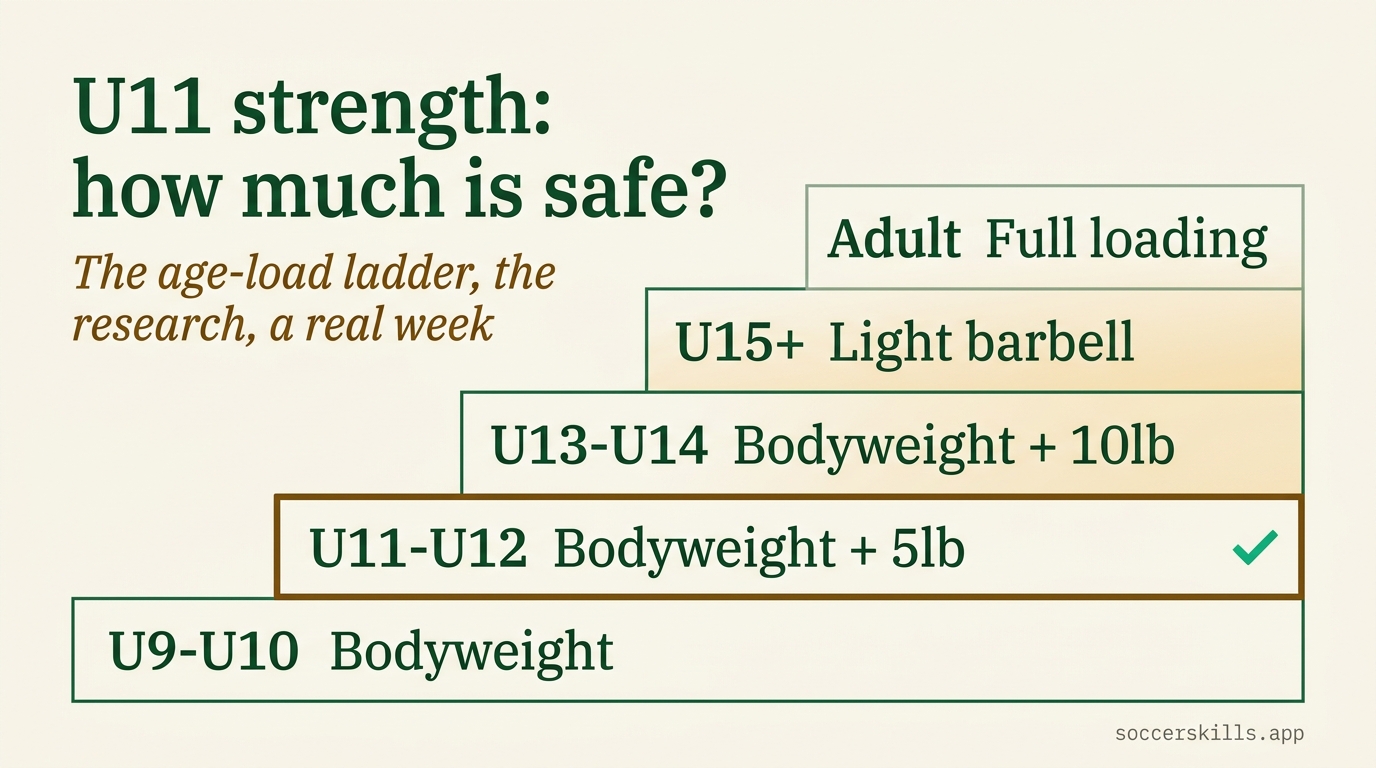
This is what every strength video in the SoccerSkills catalog uses, mapped from NSCA + AAP guidance:
| Age band | Allowed |
|---|---|
| U9 to U10 | Bodyweight only |
| U11 to U12 | Bodyweight + supervised dumbbell up to 5 lb |
| U13 to U14 | Bodyweight + supervised dumbbell up to 10 lb |
| U15+ | Add light barbell work once growth plates are closing (varies; ask their pediatrician) |
For an 11-year-old that means bodyweight squats, push-ups, planks, glute bridges, Romanian deadlifts (bodyweight or 5 lb dumbbells), bird-dogs, dead-bugs. Loaded back squats, conventional barbell deadlifts, anything heavier than a 5 lb dumbbell overhead, and max-effort 1RM lifts are out.
Every strength video served to a U11 profile clears this ladder before it plays. Not a suggestion.
why bodyweight first
Motor patterns lock in early. An 11-year-old learning a clean bodyweight squat (knees track over toes, hip hinge first, chest stays up) is building the movement template that every loaded version later will use. Sloppy bodyweight squat now = sloppy loaded squat later, just heavier.
Coordination and balance compound. A U11 who can do five single-leg deadlifts each leg without tipping over has better posterior-chain control than a U11 who can do twenty bodyweight squats but no unilateral work. The injury-prevention payoff is in the unilateral and balance stuff, not the load.
The ladder isn't "you can't lift yet." It's "lift the right thing first so loading later does what you actually want."
what a real week looks like
Twice a week, about 15 minutes each. That's the dose.
Monday after school: Bodyweight squat 3x8. Push-up 3x6 to 10 (knees down if needed). Plank 3x20 seconds. Glute bridge 3x10. Bird-dog 2x8 each side. Twelve minutes.
Thursday: Single-leg balance with eyes closed 3x15 seconds each leg. Romanian deadlift bodyweight 3x8. Side plank 2x15 seconds each side. Hop and stick (single-leg landing, hold 2 seconds) 3x5 each leg. Dead-bug 2x8 each side. Fifteen minutes.
No loaded barbell. No "until failure." No max-effort sets. Twice a week is the dose, daily strength at this age is over-training, not extra benefit.
the 8 minutes that matter most
If you only have time for one piece of pre-game prep, run FIFA 11+ Kids (about 10 minutes, validated for ages 7 to 13). Combined with the twice-weekly strength above, your U11 is getting 35 to 40 minutes of structured prep per week, which is what the research recommends.
We covered FIFA 11+ Kids in detail last week. Same framework applies for U11.
what supervision actually means
The NSCA and AAP both say "supervised." That word means specific things:
Watch the form, not the rep count. Five clean squats beats ten sloppy ones.
No competitive-loading days. "How heavy can you go" is the wrong question at U11. The answer is "5 lb dumbbells with clean form, max."
No max-effort 1RM attempts, ever. This is the hardest line for kids who watch their older sibling lift heavy. A U11 cannot test their one-rep max safely. The framework doesn't include that.
If something hurts (joint pain, not muscle fatigue), the set ends. Muscle fatigue is fine. Joint pain is not. Distinguish between the two.
A parent who's never lifted themselves can supervise effectively by watching for clean form and stopping when form breaks down. The expertise bar is lower than it looks.
Frequently asked questions
How much strength training is safe for an 11-year-old soccer player?
Twice a week, about 15 minutes per session, bodyweight movements with supervised dumbbell up to 5 lb. Loaded barbell work, max-effort lifts, and overhead press with anything heavier than 5 lb dumbbell are not age-appropriate at U11.
Does strength training stunt growth in kids?
No. The myth came from 1970s studies that confounded growth-plate injuries from competitive max-effort lifting with general resistance training. NSCA (2009, reaffirmed 2014) and AAP (2008, updated 2020) both confirm appropriate resistance training is safe and beneficial.
Can my 11-year-old lift weights?
Yes, with two conditions: bodyweight first until clean technique is established, and any dumbbell work stays at or below 5 lb with adult supervision. Barbell work is not appropriate yet at U11.
What age can a kid start strength training?
Per NSCA and AAP guidance, structured resistance training can begin around age 7 to 8 with bodyweight movements and proper supervision. The age-load ladder above scales the appropriate load by age band.
Will strength training make my kid faster?
Yes, measurably, within weeks. Strength gains in pre-adolescents are neurologically driven and transfer directly to sprint mechanics and change-of-direction speed. Plyometric work has the biggest carryover.
How is this different from what my kid's team coach does?
Most U11 team practices skip structured strength work entirely - time pressure, equipment limits, technical-drill focus. The 30 minutes a week above is supplemental and runs at home, not during practice. The team coach isn't doing anything wrong; they just don't have the time.
What if my U11 wants to lift heavy because their older sibling does?
Hard line: no max-effort 1RM attempts at U11. The framework genuinely doesn't include that, regardless of motivation. Channel the energy into mastering single-leg work and unilateral balance, both pay off in soccer-specific ways heavy lifts don't, at any age.
Want a 20-minute session for an 11-year-old that includes the FIFA 11+ Kids warm-up and the bodyweight strength sequence above? Make a free family account. The catalog is age-tagged so the wrong load never shows up.
Related: Is FIFA 11+ safe for U10? covers the warm-up half of this framework. /privacy covers what data we collect about your kid (almost none). /accessibility covers assistive-tech handling.